Showing posts with label Demonstrate in practice their knowledge and understanding of how ākonga learn. Show all posts

Tuesday, 19 September 2017

Teaching as Inquiry

One of the things that we discussed during our professional development was teaching as Inquiry. Effective leaders play an important role in establishing and promoting inquiry approaches and in emphasising the deliberate nature of teaching as inquiry .Students can also give teachers  useful information about the impact of teaching practices on their learning and engagement.
This is some of what I took out of our discussion. 

What am I missing?


Teaching as Inquiry

What is it?
 Effective pedagogy requires that teachers inquire into the impact of their teaching on their students. Modifying your teaching practices in order to best suit the students.
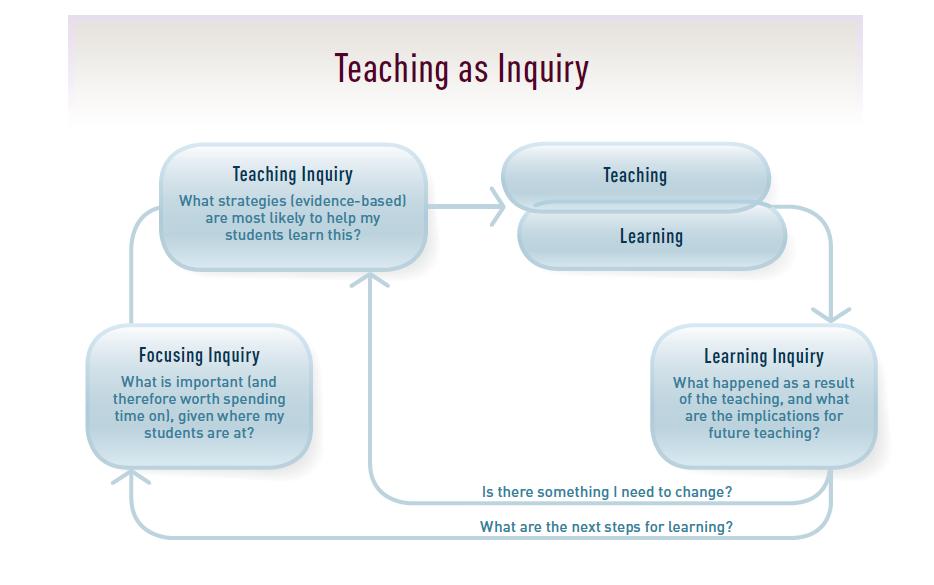
Image result for teaching as inquiry moe
What are the gaps and what are the strategies used in order to fill in these gaps?

In the focussing inquiry teachers identify the outcomes they want their students to achieve.
They consider how their students are doing in relation to those outcomes and they  ask what their students need to learn next time in order to achieve them. 


 "You need to know exactly in your mind where that student is and where they need to go next" 

Teacher ProfessionalLearning and Development


Helen Timperley - 10 key principles
1. Focus on valued student outcomes
2. Worthwhile content
3. Integration of knowledge and skills
4. Assessment for professional inquiry
5. Multiple opportunities to learn and apply information
6. Approaches responsive to learning processes
7. Opportunities to process new learning with others
8. Knowledgeable expertise
9. Active leadership
10. Maintaining momentum


"You need to continue to be a teacher of Inquiry."


"We are all on a learning journey. You do not arrive, you just get better."  -  Sarah Valentine


What happened as a result of the teaching?
What are the implications for future teaching?


Is there something I need to change?
What are the next steps for learning? 


The key question for the focusing inquiry is: What is important (and therefore worth spending time on), given where my students are at?


"Inquiry teachers  should ask more than they tell."


Kathleen Murdoch

What is your reaction to the clip?

Do you agree or disagree?

Does something challenge you? Inspire you?

Is there anything helpful to reflect on?

Some questions to we were asked to consider after our discussion were: 


What did I already know about teaching as inquiry?

What did I learn or develop understanding in relation to teaching as inquiry?

What is my next step?

In relation to teaching as inquiry, I understand that I really need  to know my learners on a deeper level in order to accelerate them. As a continue with my practice I see how I can implement things for next year so that I consistently have in my mind: Where are they at? What is working/what isn't working Why isn't it working, Where to from here?


Tuesday, 28 March 2017

Who wants to ride a bike?.... I DO!


Image result for school children riding bikesImage result for school children riding bikes


Bikes in schools aims to help many people in New Zealand to experience the many joys and benefits of riding a bike


These lessons were done over a two week period for 2hrs per session. The first session was theory based. I found it to be very informative as there were things I didn't know such as how to check your helmet before putting it on to make sure there aren't any cracks, the right pedal being at the '2 o'clock' position in order to give optimal power when they first push off their bike to ride.

The second session was a practical session. We were shown various activities that were effective as I could see myself using these activities in future lessons. I had to remind myself that this session was done with adults so the lessons need to be carefully constructed so that I can anticipate any issues before they occur.
This PD session left me looking forward to a bike session with my students.
I anticipate the first lesson being more of an assessment of who can ride a bike, who is comfortable on a bike and observing the various skills and confidence levels while on the bike. This would need to come first before any lessons could be effectively planned. 

I anticipate the set up and tidy up of each session eating up a lot of the time. As we need to take most of the bikes in, fit for helmets, fit for bike size before getting started.
Regardless of that, I did leave these sessions with a growth mindset towards teaching the lessons. 

Monday, 13 March 2017

Solo Taxonomy


This year, our school is using SOLO Taxonomy. SOLO taxonomy is a model of learning.  It is a theory about teaching and learning. SOLO stands for the Structure of the Observed Learning Outcome.

The model represents the different levels of learning outcomes as learning progresses through the many levels of understanding. 

There are 5 levels of learning.
  • Pre-structural
  • Uni-structural
  • Multistructural
  • Relational
  • Extended Abstract


Using this model, for Reading, I put together a SOLO taxonomy presentation for the students to use in order to critically summarise an article/text.
SOLO makes learning visable in any situation where there is a focus on learning. I am consistently using it in order to give feedback and feed-forward on students learning.
Using the SOLO model helps students to see the growth in their learning. Going from 'knowing nothing' to 'need help to get started' to 'this is what I now know'.

I have been using the SOLO taxonomy language across the curriculum so that the students are familiar with the terms and they are aware that it is not just used for one subject but across all learning areas. 

The unpacking of each level was the most challenging part as I needed to make sure the students understood what each level meant and what their work needed to reflect in order to reach each intended level. 

One of my future goals for this year is to reach the stage where the students are able use this model effectively to assess their own learning and the learning of their peers.